


.
.
From where TET stands.
More detail
.
This page is a machine translation that was spot-checked. The English and Japanese pages are the reference.
Robots and AI agents are starting to work for people who do not own them. With TET, the two sides sign what was agreed, the machine signs a log of what it did, and anyone holding the record and the two public keys can check it later without either side's server.
TET OS is open source.
.
.
.
Five million industrial robots were working in factories at the end of 2025, the IFR reports. Cleaning, delivery and inspection robots now work inside buildings that belong to someone else.
.
In November 2026 Serve Robotics opened a public API to its sidewalk delivery robots. Developers, businesses and AI assistants can ask for a robot, with Serve's approval.
After the job, each side has its own log on its own server, and neither can check the other's. When they disagree there is nothing both of them signed. That one record is what TET makes.
.
What we think follows.
References: IFR, World Robotics 2026 (press release, 24 September 2026), The Robot Report, 11 November 2026, ., ., .
.
.
.
Four situations.
.
From where TET stands.
.

.
From where TET stands.
.

.
From where TET stands.
.

.
From where TET stands.
.
Where you do not need it.
This is how you would run it, as a company with a fleet or as one person at home. The preview runs in this tab with test keys.
Your account is a key that stays on your device. There is no password.
The machine makes its own key, and you approve it once.
You and the other side agree on one task. Both keys sign the record before the work starts.
Each line the machine writes is chained to the line before. Open the record of any job and check it.
.
No password. Nothing was sent anywhere.
One click in this preview.
| Job | Machine | With | Record |
|---|
The pointer is moved by the page.
.
This one was signed in your browser a moment ago, with real signatures: two keys, two signatures each. Change a word or swap one signature, and the check fails.
A simplified layout made for this page. The real format and checker are in the repository.
The real checker lists 19 limits of its own. Read them further down.
.
.
.
.
A signature is data.
.
Three short films. In each, the motion is computed by a physics simulator and drawn only from rows of the log that passed the check.
Simulations. No robot moved. Test keys.
The film could not load on this page. The still above is one frame of it.
Each is at a different stage. The words on the right say which.
Prototype, in review
Cleaning, inspection, delivery.
A cleaning company's robot cleans a bank's lobby at night.
It does not say who cracked the glass.
Sample records and an offline checker are in the public repository today.
Planned
A site asks a robot that is free nearby to do one task.
Saturday morning. A café's delivery is at the back door.
.
.
.
.
At least one fleet owner has opened its robots to outside requests itself.
.
.
A mock-up of an app that does not exist yet. The four signatures are real and are checked in this tab.
In review
One company's agent hands work to another's.
.
.
.
.
References: Fortune, 2021, Linux Foundation, 2025
The aim is an agent that holds its own key.
You let your assistant change one booking, once.
1×Permit: change one booking, once
One permit, used once. The second use is refused in the same log.
Built in, not complete
Every signature comes as a pair.
A record of an inspection is signed today and pulled out twenty years later.
A record may need to be checked many years after it was signed.
Further out is research on signatures that can be made only once.
One limit the checker states itself.
Both must match, so this forgery is refused.
Your key signs a one-time challenge. No password is sent or stored.
Prototype, in review.
The site sends a random challenge that is used once.
Limits.
A maker's key signs a tag on the thing. Each hand-over adds a line both sides sign.
Tags: prototype. Hand-over lines: idea.
The maker's key signs a tag fixed to the thing.
Limits.
A members-only board or a vote where a member shows it belongs without showing which member it is.
Idea.
A group publishes the list of its members' public keys.
Limits.
.
Idea, not built
.
.
.
Others are working on signed records for machines and AI agents, mostly as IETF drafts. This is where TET's sketch is the same, where it differs, and where it is behind.
The difference is who signs.
.
| What is compared | One side's own logcommon today | Signed receipts for agents and machinesRFC 9943 and current IETF drafts | TET two-party recorda design sketch, v0.2 |
|---|---|---|---|
| Who signs | The operator alone, or nobody. | One signer. The other owner confirming it is out of scope, or absent. | Both sides. It does not show that either side received the other's signature. |
| Can be checked without a server | No. You ask the operator. | Yes. | Yes. This is the same as the others. |
| Two signatures, one built for quantum computers | No. | Not in the texts read. One draft has it in part. | Yes. Both must match. |
| Shows that nothing was dropped or cut off | No. | In part. The end of a log needs an outside witness. | In part. Only up to the position the other side holds. |
| Says who allowed a key to act | Only inside one company's system. | Out of scope, or absent. | No. A permit is signed by the same key that uses it. |
| Works with existing agent standards | Does not apply. | Mostly not yet. One draft, in part. | No. |
| Where it stands | In use everywhere. | RFC 9943 is published. The drafts are in progress. | A sketch in review. Nobody uses it yet. |
From a read of RFC 9943, RFC 9942 and three current IETF drafts on 26 November 2026. A draft can change, and this table will be wrong when it does.
This is the real checker from the repository, not this page's demo. It makes nine sample records, three honest and six broken on purpose, and says what it finds for each.
git clone https://github.com/TET-Network-Foundation/TET-OS
cd TET-OS
RISC0_SKIP_BUILD=1 cargo build -p tet-cli --release
export TET_CLI=$PWD/target/release/tet-cli
python3 prep/demos/two-party-v0/samples.py make samples-out
python3 prep/demos/two-party-v0/samples.py check-all samples-out
Copied from a run on the author's laptop, with the exit-code lines left out: sample records at commit b569377, throwaway keys, a made-up chain. Its own list of what it does not show is longer than its list of what it shows.
$ python3 prep/demos/two-party-v0/samples.py check-all samples-out
broken-a-ed25519-half: expected SIGNATURES: invalid / LOGS: not checked; got SIGNATURES: invalid / LOGS: not checked; MATCH
broken-b-ml-dsa-half: expected SIGNATURES: invalid / LOGS: not checked; got SIGNATURES: invalid / LOGS: not checked; MATCH
broken-c-summary-changed: expected SIGNATURES: invalid / LOGS: not checked; got SIGNATURES: invalid / LOGS: not checked; MATCH
broken-d-permit-used-twice: expected SIGNATURES: valid / LOGS: conflict at a (cause not shown); got SIGNATURES: valid / LOGS: conflict at a (cause not shown); MATCH
broken-e-number-skipped: expected SIGNATURES: valid / LOGS: conflict at a (cause not shown); got SIGNATURES: valid / LOGS: conflict at a (cause not shown); MATCH
broken-f-one-key-both-parties: expected SIGNATURES: invalid / LOGS: not checked; got SIGNATURES: invalid / LOGS: not checked; MATCH
honest-1: expected SIGNATURES: valid / LOGS: as promised; got SIGNATURES: valid / LOGS: as promised; MATCH
honest-2-permit: expected SIGNATURES: valid / LOGS: as promised; got SIGNATURES: valid / LOGS: as promised; MATCH
honest-3: expected SIGNATURES: valid / LOGS: as promised; got SIGNATURES: valid / LOGS: as promised; MATCH

$ python3 prep/demos/two-party-v0/samples.py check samples-out/honest-2-permit
SIGNATURES: valid
LOGS: as promised
Shows:
  - that both pinned keys signed exactly this record, each with both halves
  - which two keys the record names, that they are the two pins given, and that the parties name two different keys of each kind
  - with a party's export: that this export holds the record at the named number, after the named record
  - with a cited permit and that party's export: that this export cites the permit once, from that record
Does not show:
  - that what was agreed is true, or what the agreed document says (only its hash is here)
  - that either side still holds the agreed document and its random value, or that anyone received them; without the value nobody can open the agreed hash in a dispute
  - that the random value was fresh: nothing enforces it, and one document and value used for two deals link their records
  - when anything happened: the record shows order inside each log, never a date
  - who signed before the other, that either side received the other's signature, or that both logged it at about the same time
  - which person or organisation holds a key, that a key was not copied, or that a person and not software decided to sign
  - with one signature: only that one key signed; it is not a deal, and it does not show that the other side saw it
  - without a party's export: that it kept its copy
  - that a party keeps only one log: its key holder can copy the folder and write another record at the same number
  - who caused two records at one number: there is no fair exchange, so a side that held back its signature can complete an old record later
  - that a key signed only one record per number: the reservation binds this sketch's sign() and append(), not the key; a signature made with another tool, an ordinary notebook entry or a copied folder can still take the number
  - that a log was not cut back or rewritten after the last position a counterparty holds; before it, only if the counterparty brings its record
  - that anyone but the device allowed anything: the permit is signed by the same key that cites it, and its terms are not in the record
  - that a permit was not used in another notebook: once is once per notebook
  - privacy of the rest of the log: an export holds the whole log, and the same two key ids link every record of one pair
  - that the summary looks like what it says: control and format characters are refused, but look-alike letters and other invisible fillers pass
  - that the summary holds no name: the tool cannot tell
  - anything against a quantum forger for a checker whose pins came over a channel such a forger can fake
  - that the format is final: this is a design sketch in review
.
.
.
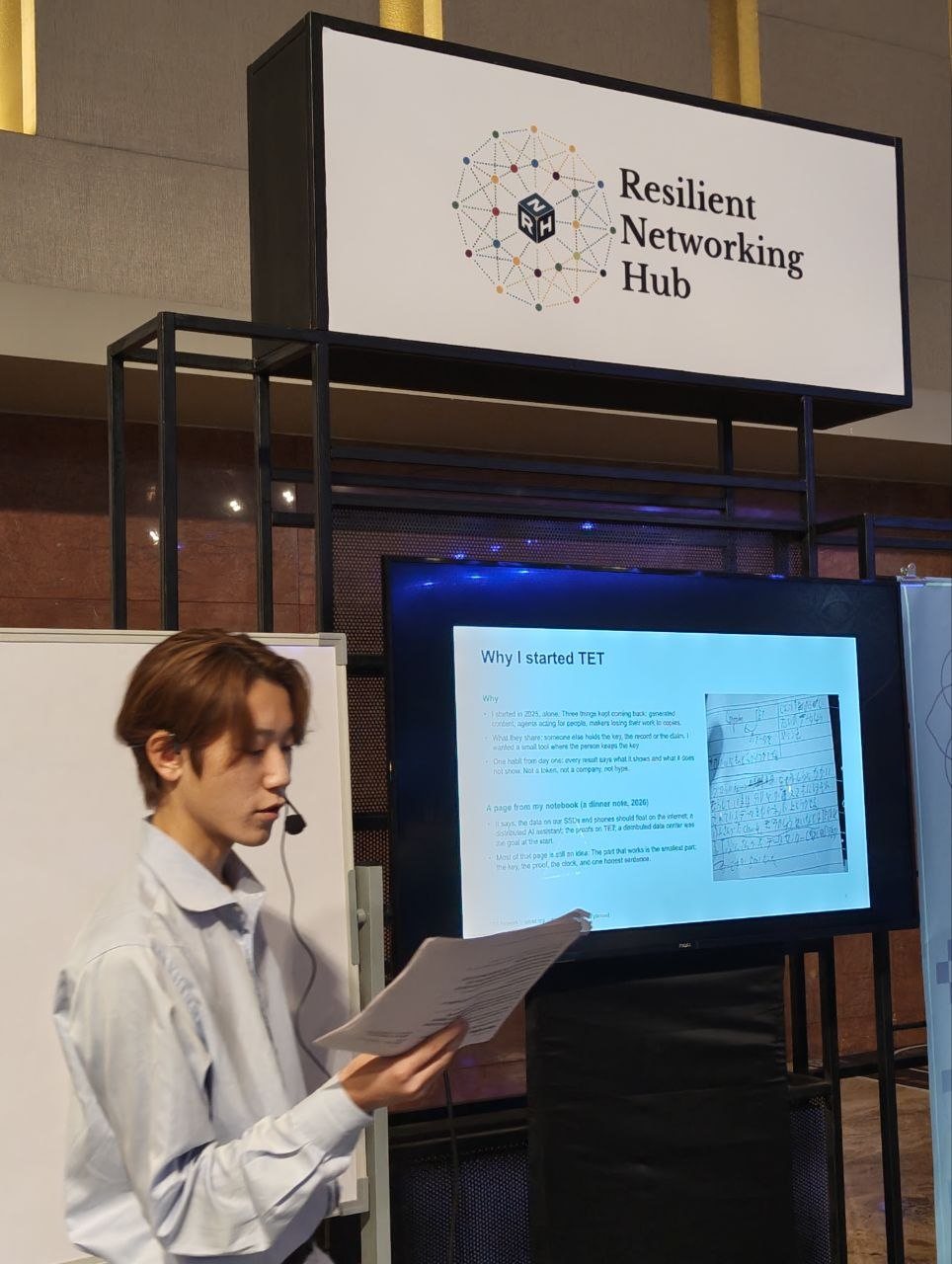
TET is built by Steve (Kazuma Sengoku) in Switzerland, with AI coding tools. He decides the design and what each page is allowed to claim.

.
.
A test here only counts if it fails when the bug is put back. Each result we publish comes with two lists: what was checked, and what was not.
No token. Open source.
Contact: tetsteve@proton.me, Telegram, X @stevenexusz, GitHub

.
.